AI-Assisted Drafting
for CCH iFirm
Removing the blank page from client documents
Our users were already using AI. They were just using it outside the product.
The brief was about editing. The real problem was starting.
Professionals already used ChatGPT to draft emails and written content during their working day.
Our product still gave them a blank page to start from.
Bring that behaviour into the product. Improving the editor would make the blank page slightly better. AI-assisted drafting could remove it.
- 5Foundational research sessions conducted in 2024 on AI and usage among Wolters Kluwer customers
From template to AI assistant
Accounting and tax professionals regularly create documents that clients need to review and sign. The original requirement was to improve the document editing experience.
Route
What it meant
Friction
Template
Rarely fit the actual client situation.
Heavy editing anyway
Write from scratch
Slow, and introduced typing errors in client-facing documents.
Risk in a signed document
Leave the product
Draft in an external tool, then paste the content back.
Client information leaves the system
Make document creation faster and keep the workflow inside the product.
Every route was slow.
The product handed professionals an empty page at the exact moment they needed to start writing.
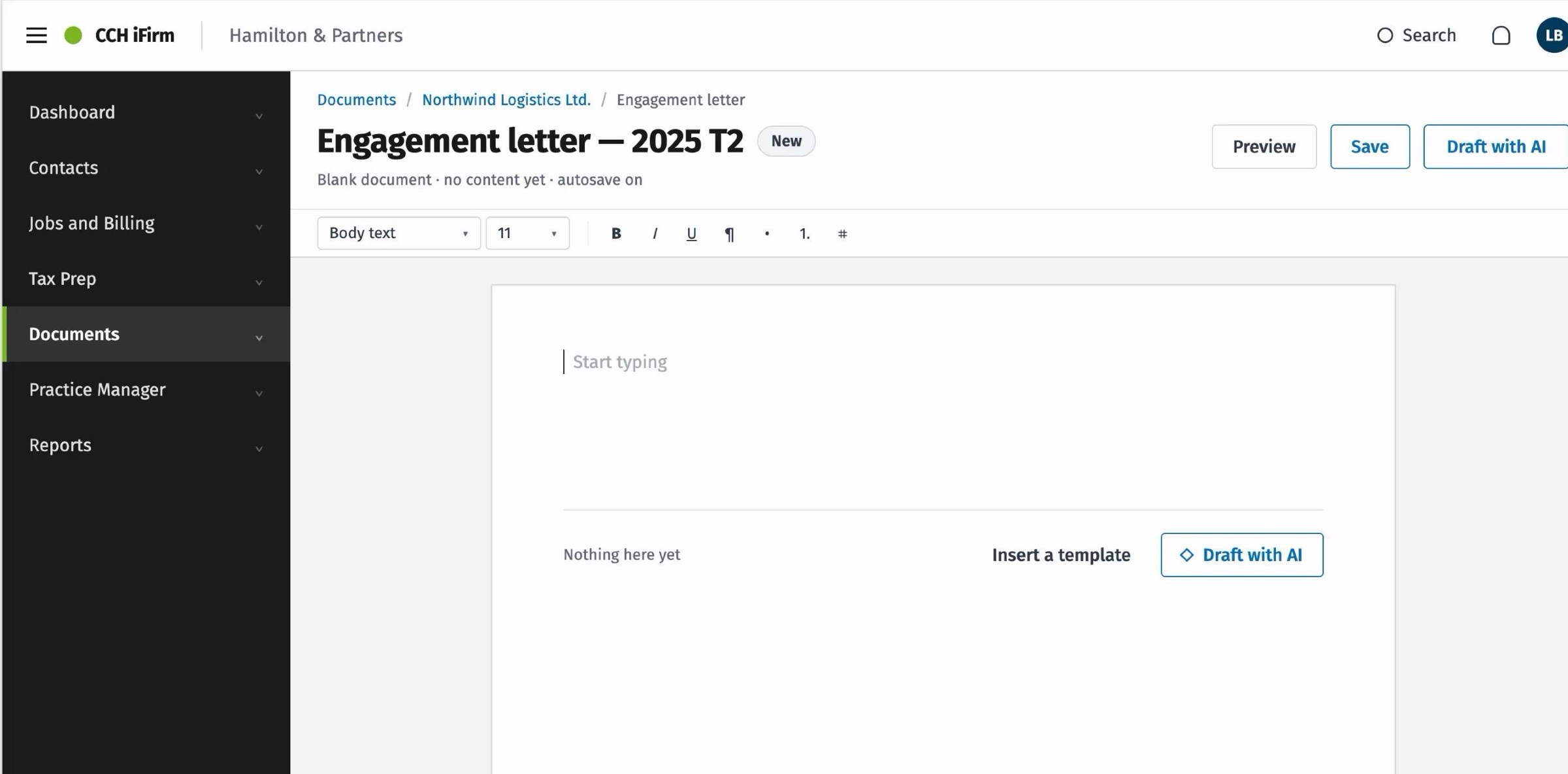
Make document creation faster and keep the workflow inside the product.
Turn a document-editing requirement into an AI-assisted drafting experience
- Original brief · Improve editing
- Reframed problem · Remove the blank page
- Proposed direction · AI-assisted drafting
AI was not in the original requirement. I proposed AI-assisted drafting based on research we already had.
I defended the direction using the existing user research rather than a new discovery cycle.
Stakeholders expanded the scope of the initiative and phased the work into the roadmap.
Don't optimise the blank page. Remove the blank page.
AI had to fit a professional workflow, not replace it
Creates a first draft
From the professional's instruction.
Reviews · Edits · Approves
- 01Nothing is stored before approval
- 02Nothing is sent before approval
- 03The professional stays accountable for the content
Receives the final document
Only after human approval.
Review is not a step after generation. Review is part of the product.
Research shows users don't reliably verify AI outputs by default.
Appropriate reliance on Generative AI: research synthesis · Microsoft
The AI creates a starting point. The professional stays responsible for the final document.
Generate → Review → Decide
Start
A document is needed for a client.
Instruction
The professional describes what the document should say.
AI draft
A first version replaces the empty page.
Review and edit
The professional reads, corrects and adjusts.
Approve
Explicit human decision.
Save or send
The document goes to the client for signature.
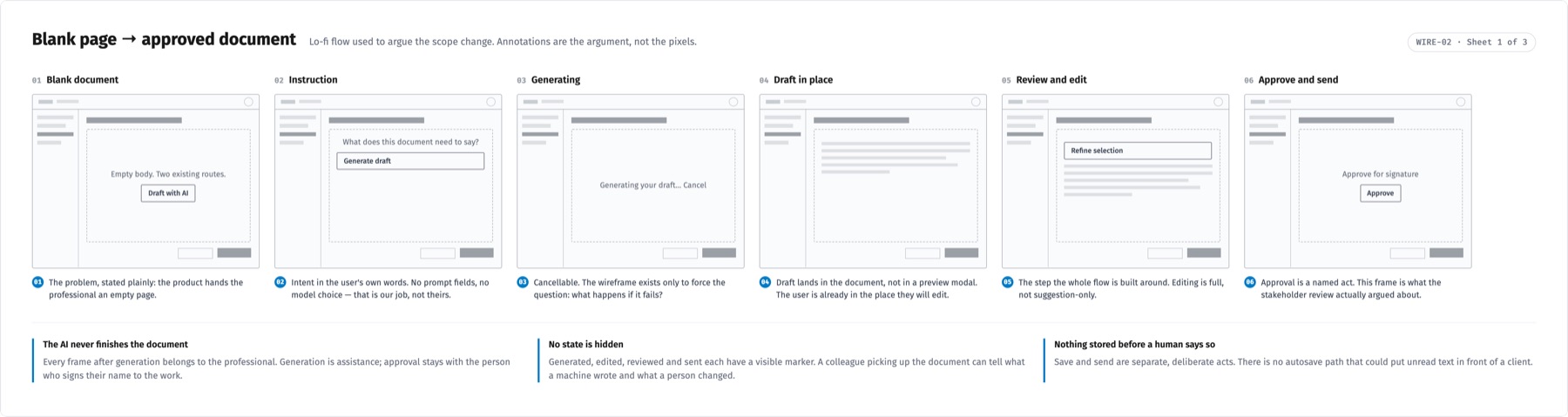
Intent in plain language. No prompt fields and no model picker: choosing the model is the product's job, not the professional's. The panel states what it will not do before it does anything.
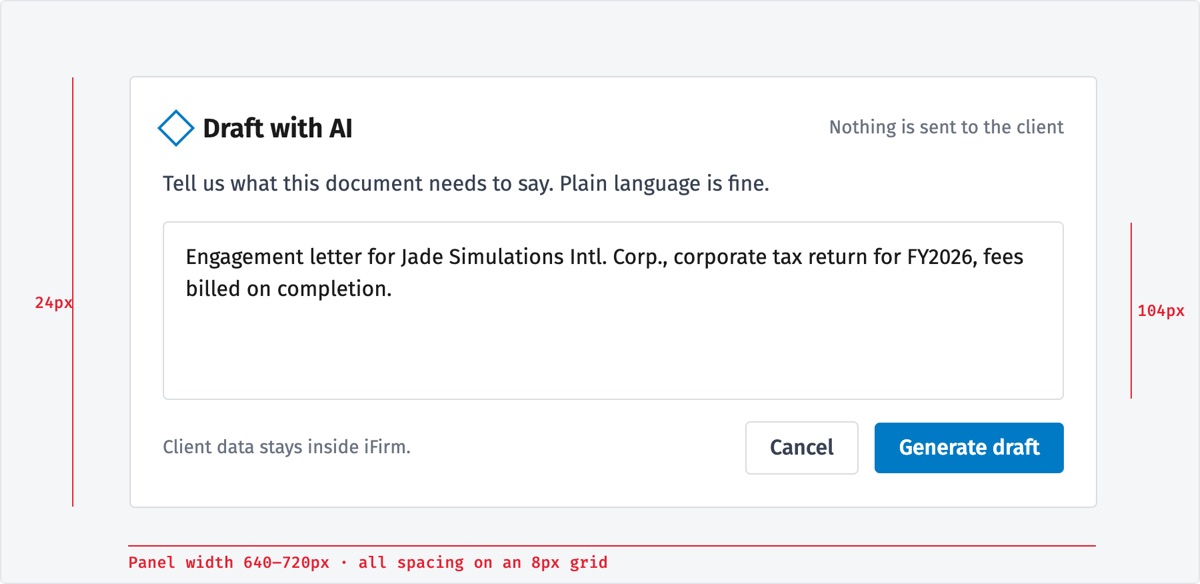
Three of the notes the specification carries, so they are built rather than retrofitted.
- 01The panel is a labelled region, not a dialog. It does not trap focus, and the document stays readable and editable behind it.
- 02Generation progress is announced politely, so a screen reader hears that work is happening without the draft interrupting whatever is being read.
- 03Colour is never the only signal. The rail that marks machine-written text is paired with a chip that says so in words.
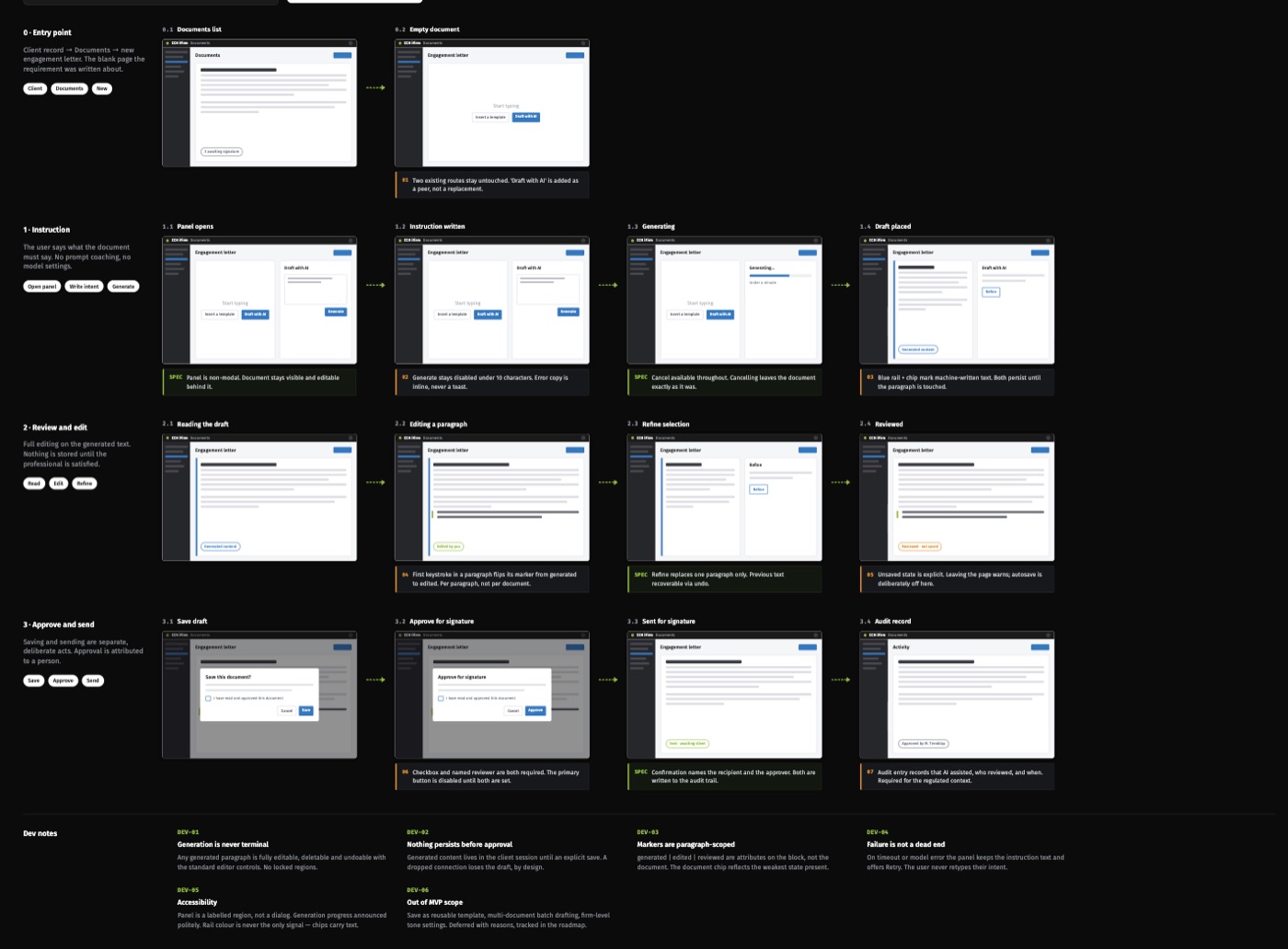
Not everything useful belongs in the first release
Templates introduced a second lifecycle: ownership, versioning, editing rights and what happens when the underlying rules change.
Validate the core drafting behaviour first. A smaller MVP gave us a safer way to validate the core behaviour before introducing lifecycle complexity.
Test small. Release for real.
- 01Is it intuitive?
- 02Is it useful?
- 03Does the review model feel appropriate?
3 of 3 trusted customers validated the concept positively.
A directional signal, strong enough to justify building the MVP. Not statistical evidence.
From strategic proposal to shipped AI feature
Product strategy
Reframed the brief from editing to starting.
AI product design
Proposed AI-assisted drafting and the human review model.
UX
Designed the end-to-end navigation and interaction flow, from wireframes to validation concepts.
MVP
Defined what shipped and what was deferred.
Defended the direction; scope was expanded and phased into the roadmap.
- Concept
- Validation
- Roadmap
- MVP
- Canadian release
I helped turn an AI opportunity into a product decision and a shippable MVP.
Are people reading what the AI wrote?
No product analytics were available to me on this work, so this is the plan rather than the result. Written as it would go to the team.
AI moved from an external workaround into the product
A faster way to get started
No empty page, and no leaving the product to draft elsewhere.
AI-assisted document creation inside CCH iFirm
With human review built into the flow, not bolted on.
A validated MVP released in Canada
3 of 3 customers validated the concept. Users needed to accelerate their workflow with AI.
I thought this was a tool for contracts. People used it for anything that needed a signature.
My working assumption throughout design was that the feature served formal, structured documents: engagement letters, contracts, the heavyweight paperwork of a practice.
In use, the pattern was broader. People reached for it for anything that required a client signature, including short, routine correspondence. The opportunity was wider than the brief, and wider than my own framing of it.